
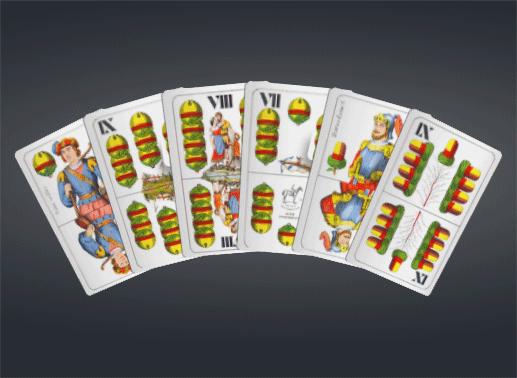
Belot (better known as Bela) is a card game widely played in Croatia, Bulgaria and Bosnia. It can be played by two, three or four players, but it is most often played by four.
Every hand consists of dealing, choosing trumps, declarations, play and scoring.
Dealing and choosing trumps
Belot is played with a 32-card deck (ace, king, queen, jack, 10, 9, 8, 7) or with Hungarian-pattern cards, where the suits hearts, clubs, spades and diamonds are replaced by acorns, leaves, bells and hearts. After shuffling, the dealer offers the deck to the player on the left to cut (that player may cut, or tap the deck to show they do not want to). Cards are dealt counter-clockwise. A player may pick up their cards only when it is their turn to name trumps; otherwise the penalty is the whole game (162 points).
The main feature of four-handed Belot is that it is played in pairs. Two opposing partnerships each try to collect half of the total points plus one.
Every player receives three cards face down, then three more (six in total), and finally two cards for the talon, which are kept apart from the first six.
The first six cards are picked up and the choice of trumps begins. The player to the dealer's right goes first. A player may look at the cards only when naming trumps, and puts them back on the table when passing.
A player decides whether to name trumps or to pass. On a pass, the talon is picked up and the right to name trumps moves to the next player on the right, with the same rights as the previous one. When it is the dealer's turn, the dealer must name trumps. Once trumps are named, everyone picks up their talon and play begins.
Declarations
A “declaration” is a special combination of cards in a player's hand that earns extra points. There are four kinds of declarations:
-
Four cards of the same rank:
- 4 jacks: 200 points
- 4 nines: 150 points
- 4 aces, tens, kings or queens: 100 points
Four eights and four sevens are worth nothing.
-
A sequence in the same suit (3 to 5 cards). For declarations the cards
rank: ace, king, queen, jack, ten, nine, eight, seven.
- 3 cards in sequence in the same suit: 20 points
- 4 cards: 50 points
- 5 cards: 100 points
- Six or seven cards in sequence in the same suit count the same as a five-card sequence, i.e. 100 points.
- Eight cards in sequence in trumps are called “belot”, and the player holding them wins outright, whatever happened earlier in the game (as if they had scored 501 points in two-handed, 701 in three-handed or 1001 in four-handed Bela at once).
- Like the game itself, “bela” is also the name for holding the king and queen of trumps. Bela is worth an extra 20 points.
The strongest declaration must always be announced first; if it turns out a player held a stronger one, the first declaration is the one that counts.
Declarations are counted only for the partnership with the strongest (highest) declaration (bela is the exception). The other partnership gets nothing, even if it holds several weaker declarations that would add up to more than the opponents' one.
Four of a kind (except eights and sevens) beats a five-card sequence. Between two sequences of the same length, the one with the higher top card wins, so eight-nine-ten-jack is weaker than nine-ten-jack-queen.
If two players from opposing partnerships have declarations of equal value, the one who had the earlier right to name trumps wins (the one closer to the dealer on the right). Overlapping declarations are allowed (the same card may be part of two declarations).
Declarations are shown right at the start of play. The other players are asked whether they have a declaration and how much it is worth, until it is clear who scores it (bela is the exception).
A player holding the king and queen of trumps announces bela the first time they play one of those two cards. The player must make it clear to the others by saying “bela” when playing the king or the queen for the first time. Announcing bela is mandatory; mentioning it again with the second card is not, although the player may say “from bela”.
In four-handed Bela, when a player has the right to declare, their partner automatically has it too.
Play
The player to the dealer's right leads. The next player must not only follow suit but also play a higher card than the previous one. For example, if the first player leads the eight of spades and the next player holds the seven and the ten of spades, they must play the ten, not the seven. A player must always play a higher card if they have one. A player who cannot follow suit must play a trump. With no trumps either, any card may be played.
If a trump is led, the next player again has to play a higher trump if they have one. But if a non-trump suit is led and a player who cannot follow suit trumps it, the following player may play the suit that was led and does not have to play a higher card, because the trick has been trumped.
For example, hearts are trumps and the first player leads the eight of spades. The next player has no spades and plays any heart. The player after that holds the ace and the seven of spades and may freely play the seven, because the higher-card rule no longer applies once a suit has been trumped. The player who played the strongest card wins the trick and leads to the next one.
If any of these rules is broken, the opponents score 162 points. The hand ends there and a new deal begins.
Scoring
Every player collects their own tricks.
The player who wins the last trick gets an extra 10 points. A player or partnership that has not won at least one trick does not score their declarations (bela included). If a player or partnership wins all the tricks, they get an extra 90 points.
A so-called clean game (a hand without declarations) is worth 162 points. The player or partnership that named trumps must collect at least half of the total plus one to pass. So in a clean game 82 points are needed; otherwise the bidders do not pass but “fall”.
The total grows with the declarations made in the hand. All declarations are added to 162, and passing again requires half of that sum plus one (with a 20-point declaration the game is worth 182 and passing takes 92; with a 50-point declaration the game is worth 212 and passing takes 107).
If the partnership that named trumps passes, i.e. collects half of the total plus one, each partnership scores the points it collected.
If the partnership that named trumps falls, i.e. does not collect half of the total plus one, the opponents score all the points.
A fall is written down as a dash, not a zero.
Card values (points)
| In trumps | Not in trumps | ||
|---|---|---|---|
| Jack | 20 | Ace | 11 |
| Nine | 14 | Ten | 10 |
| Ace | 11 | King | 4 |
| Ten | 10 | Queen | 3 |
| King | 4 | Jack | 2 |
| Queen | 3 | Nine | 0 |
| Eight | 0 | Eight | 0 |
| Seven | 0 | Seven | 0 |
Winning
When does it end? In the final, deciding hand a player or partnership only needs to collect the points still missing to reach the agreed target, regardless of whether they collected half of the total plus one. For example, in two-handed Bela a player with 496 points needs only 5 more; if their first card is the jack of trumps, the strongest card in the game and worth 20 points, the game ends right there. Only the partnership that wins a trick can finish.
Under the official rules a player must both reach enough points and win a trick.